
Seeing
observation, control, and what flourishes with deeper knowing

Many of us have been taught that Orange is named after the fruit, and Pink originated from a flower. The royal color of Purple comes from a Latin term for the shellfish used to make the dye.
We have not always learned to see and understand color the way other cultures have. There is a layer of knowing — subtle and instinctual — that we have never fully known.
I am moved by how Japan’s old soul breathed meaning into its colors, drawing their names from nature. Japan embodied color. It captures a feeling.
Here are some examples of Red from the deepest to the most translucent pale.
Ni 丹: Minium Red Lead, a primal red born of heat and transformation, symbolizing rebirth.
Akane 茜: Madder Root, an ancient red dye derived from creeping roots, evokes the twilight sky.
Arazome 退紅: Safflower, a fleeting red capturing the ephemerality of passing time.
What does this have to do with seeing?
Stay with me as we walk through the evolution of color so I can share what may be happening to us unknowingly.
The Beginnings of Color
A thousand years ago, during the Heian period in Japan, they were not just naming colors but bringing their observations of nature to color. They saw the world differently. With no information, they read nature—the seasons of a leaf, clouds before a storm, the sun rising, all subtle shifts in color.
When did the beauty of seeing start to change?
In the 1850s, something began to shift. Synthetic dyes emerged in Britain, giving us control and predictability.
We no longer needed to observe nature, to wait for seasons, to train the eye to see and the heart to feel.
With deeper knowing, the essential can begin to flourish again.
Are we losing something important?
I sometimes wonder if this loss of seeing extends beyond color.
We may be losing our ability to truly see one another as human beings.
We take in opinions as finished truths.
We react before we observe.
Slowly, almost unknowingly, we close our own hearts.
In doing so, we dim our capacity to connect. It is not something done to us — it is something we participate in when we stop looking with depth.
How can we see again?
Start slowly by being willing to let go of control and perfection of the outcome. Let it happen. Let it guide you.
There is a quiet beauty in uncertainty. We can learn to listen and trust ourselves.
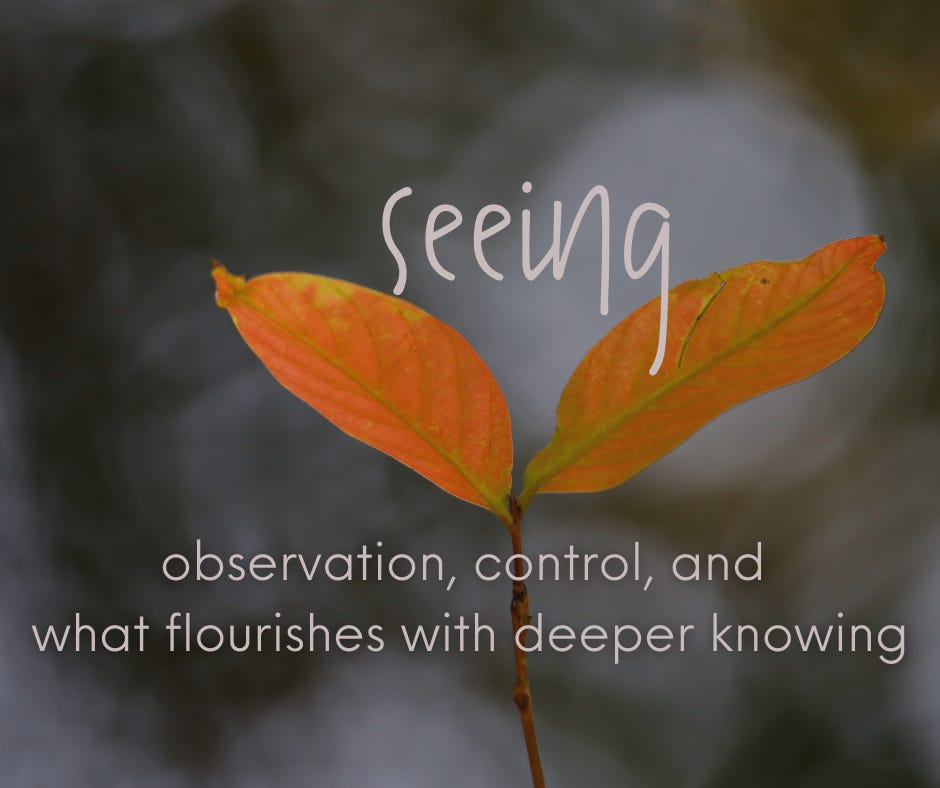
We become more open to the seasons of a leaf.
We start to understand the quality and release the quantity.
Seeing is not something we have lost completely.
It is something we can choose to practice again.